
A City For Optimists
Neurodivergence and The New York Knicks

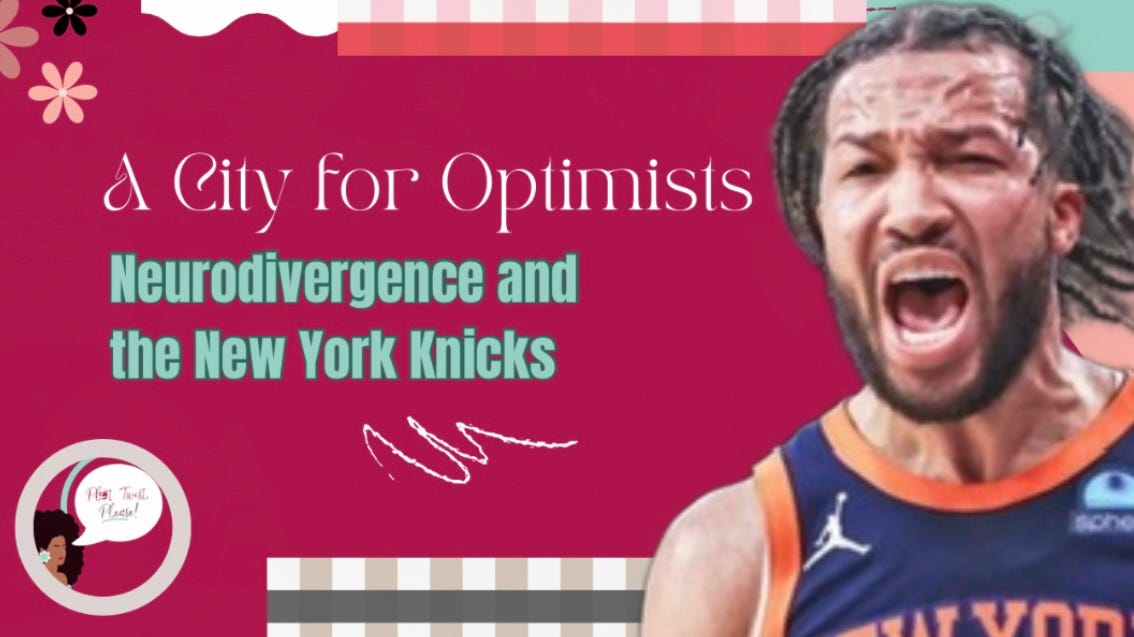
I am not a sports fan, but I might as well be one.
There are so many inspiring stories about athletes who spent years being discounted, having the odds stacked against them, and having to show up every time, giving 100%. As a theatre performer, I can relate to long nights practicing, aiming for as close to perfection as possible that day, and understanding that the mind is most of the battle. Maybe that’s why I cried after the Knicks won the World Championship. Perhaps, I understand, on a visceral level, how hard you have to fight for sled-belief when you’ve been working at something for a long time, when you are dealing with obstacles beyond your control, and/or when you can sense that you are an “underdog.” (I don’t claim to be an “underdog,” but I’m certainly not an “overdog,” I suppose.) For those who don’t know, here are a few reasons why this weekend’s win has been such a big deal:
This is their first NBA Championship win in 53 years, making the last time they won during a time when women couldn’t have credit cards.
Knicks fans have constantly gotten a bad rap for “keeping hope alive,” and most people didn’t see this coming.
Without getting into specific jargon and at the risk of exposing my sports ignorance, the team is full of players who had limited resources, be it physical makeup and/or status, who have been known for working extremely hard.
The Knicks are something that all New Yorkers, with few exceptions, agree on.
I firmly believe that New York is for optimists. It’s not somewhere you land unintentionally. The people who live here aim to be here for very specific reasons. They are dreamers and doers. Even when they pretend otherwise, they love fanfare, strangers embracing, and crowds cheering in subway stations. They love how you can walk through your door from a 10-hour shift, ready to collapse, and then decide five minutes later that your night isn’t over. They love the notion of stepping out into the street and watching it fill with people within the hour. They throw themselves into spaces where things happen, and they do so because they know that, one of these days, something is going to happen to them. Whether they like to admit it or not, they are some of the most whimsical people in the world. Rain or shine, they’re outside. Yes, rent is high, but it’s worth it because something might change their life today. New Yorkers, from my limited perspective, thrive on unlimited hope. Their coffee is flavored by “maybe,” and their bagels are topped with “someday.”
New York is a city of romance, and its inhabitants are the ultimate dreamers.
If I’ve learned one thing as an autistic person, it’s that being hopeful will make you look ridiculous. You might even look ridiculous for an uncomfortably long amount of time. The pay-off, though? This is what it feels like.
I have, for a while, longed to be in an environment where I am encouraged to feel hope with every fiber in my body—to use my unique perspective and the things that have set me apart to drive me forward. And with that, I have known, for years, that I would end up here—in this place.
Admittedly, I am someone who will experience hope, envisioning a moment I want to replicate in real life, and be suspicious afterward. Reader, I am learning to keep my suspicions at bay, as difficult as it may be.
You may be having a similar revelation. If not, I invite you to. As people who have a deep-seated fear of being misperceived, not being taken seriously, or being treated as if we’re stupid, I understand why this approach is unappealing. Maybe the air is different over here, but I’m breathing it just fine. I hope that you, even if you’re cautious, decide to take it in.
-CM